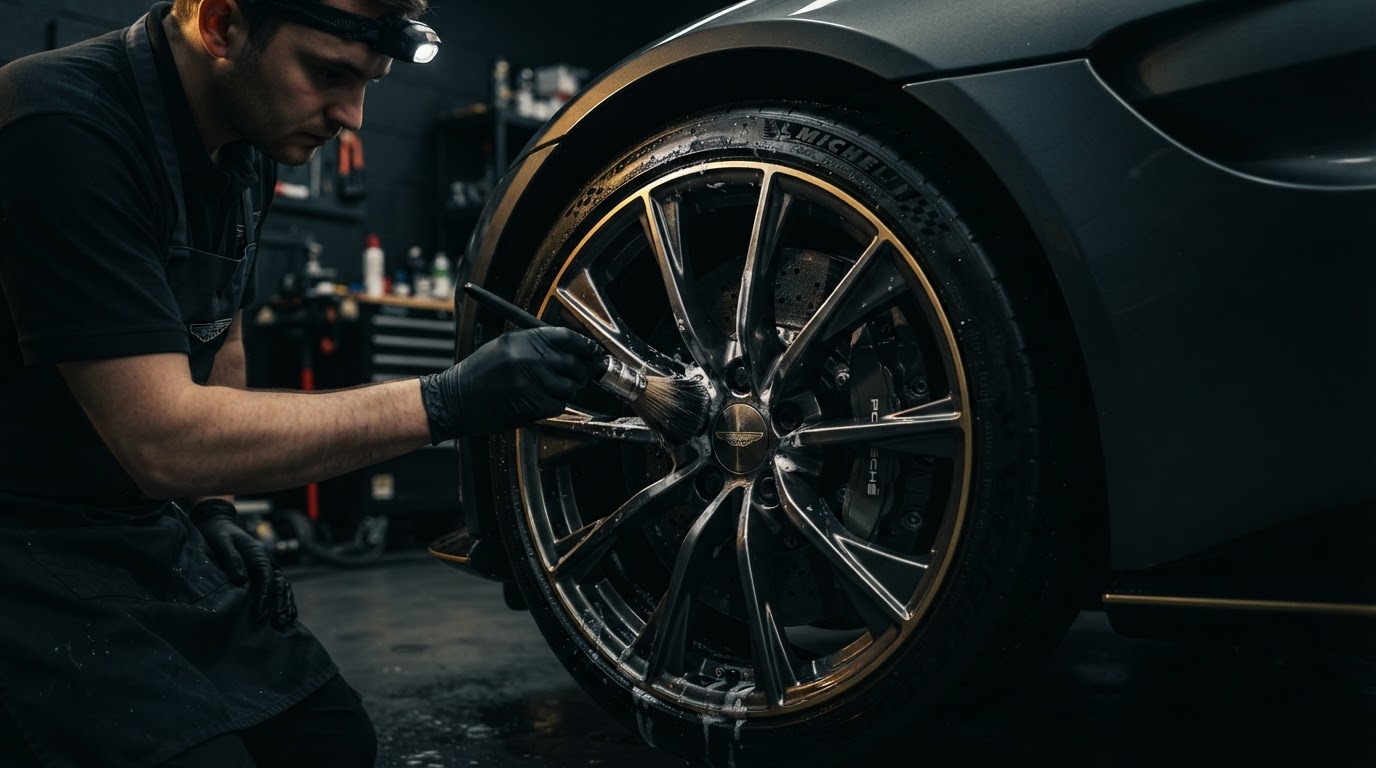
Wheel Detailing in NYC
Wheel cleaning and detailing to remove brake dust and restore finish.
Wheel detailing in NYC removes brake dust, road grime, and iron contamination from your wheels to restore their finish. Wheels collect some of the harshest contaminants on a vehicle, so dedicated wheel cleaning and surface care are essential to a complete detail.
What This Service Covers
Our Detailing Process
1Pre-Rinse
Wheels are rinsed to remove loose dirt.
2Clean & Decontaminate
Wheel cleaner and brushes remove brake dust and iron contamination.
3Protect
Wheels are dried and a protective layer is applied for easier future cleaning.
Why Wheels Need Dedicated Detailing
Why Wheels Need Dedicated Detailing
Wheels are subjected to the harshest conditions on a vehicle. They sit closest to the road, collecting brake dust, road grime, tar, iron particles, and the general contamination of city driving. Brake dust, in particular, is a mix of metal and carbon particles that bakes onto the wheel surface under the heat of braking, forming a stubborn layer that ordinary soap struggles to lift.
In NYC, where stop-and-go traffic produces constant braking, brake dust accumulation is heavy. Add road salt in winter, tar from road work, and the general grime of city streets, and wheels face a level of contamination that the rest of the vehicle does not. This contamination, if left, can pit, stain, and corrode the wheel finish over time.
Wheel detailing in NYC addresses this with dedicated cleaning and decontamination. Rather than a quick wipe during a car wash, the wheels receive focused attention with products and tools designed to remove baked-on brake dust and iron contamination, restoring the wheel finish and protecting it from damage.
The Wheel Detailing Process
The Wheel Detailing Process
Wheel detailing begins with a pre-rinse to remove loose dirt and grime. This clears the surface contamination so the cleaning products can focus on the bonded contamination beneath. The wheels are then treated with a wheel-specific cleaner, formulated to break down brake dust and road grime.
An iron remover is often applied, reacting with the embedded iron particles from brake dust and turning them purple as they dissolve. This chemical decontamination lifts the iron that has bonded to the wheel surface, allowing it to be rinsed away. For tar and other contamination, dedicated removers address each specific contaminant.
Brushes of various sizes are used to reach between spokes, into the wheel barrel, and around lug nuts — areas where contamination collects and that ordinary cleaning misses. The brushes agitate the cleaner, lifting the grime from every surface. The wheels are then rinsed, dried, and protected.
Brake Dust and Iron Contamination
Brake Dust and Iron Contamination
Brake dust is the primary contaminant on wheels, and it is more damaging than it appears. The dust is a mix of metal particles from the brake pads and rotors, carbon, and adhesives, and it is produced every time the brakes are applied. Under the heat of braking, this dust bakes onto the wheel surface, bonding with the finish.
The iron in brake dust can embed in the wheel's clear coat, causing the orange-brown speckling visible on many wheels. Over time, this embedded iron can pit and corrode the finish, especially on clear-coated wheels. Removing it requires iron-specific chemicals that dissolve the ferrous particles, not just surface cleaning.
Wheel detailing addresses both the visible brake dust and the embedded iron. By combining chemical decontamination with mechanical brushing, the process removes the full range of wheel contamination, leaving the surface clean and smooth and protecting the finish from the damage that bonded iron can cause.
Wheel Surfaces and Finishes
Wheel Surfaces and Finishes
Wheels come in a variety of finishes, each requiring appropriate care. Painted and clear-coated wheels, the most common, can be cleaned and decontaminated with standard wheel products, though harsh acids should be avoided to protect the clear coat. Polished and bare aluminum wheels require gentler, non-acidic products to avoid staining.
Chrome wheels need specific care to avoid pitting, while matte and satin finishes require products that do not alter the finish or add gloss. An experienced detailer identifies the wheel finish and selects the appropriate products and techniques, ensuring the wheels are cleaned effectively without damage.
Whatever the finish, the goal is the same: remove the contamination, restore the appearance, and protect the surface. For wheels with existing damage — pitting, staining, or clear coat failure — more intensive restoration may be needed, but regular detailing prevents most damage from developing.
Protecting and Maintaining Wheels
Protecting and Maintaining Wheels
After cleaning and decontamination, a protective layer is applied to the wheels. This can be a wheel sealant, a ceramic coating, or a protective dressing, all of which create a barrier between the wheel finish and the contamination it faces. The protection makes future cleaning easier, since contamination bonds to the protective layer rather than the wheel itself.
For NYC drivers, wheel protection is particularly valuable given the level of brake dust and road grime. A protected wheel stays cleaner longer, washes more easily, and resists the pitting and corrosion that unprotected wheels suffer. Combined with regular cleaning, it keeps wheels looking their best over time.
Explore our exterior car detailing, tire detailing, and ceramic coating services to see how wheel detailing fits into a complete exterior care program. As a standalone service or part of a full detail, professional wheel detailing removes brake dust and iron contamination and restores the wheel finish.
FAQ
Wheel Detailing NYC — Frequently Asked Questions
Can you clean all wheel types?
Yes, with cleaners and methods matched to the wheel finish.
How do you remove baked-on brake dust?
Iron-removal chemicals and brushes dissolve and lift stubborn brake dust.
How often should wheels be detailed?
With every full detail, plus regular cleaning between details.
Can brake dust damage wheels?
Yes, embedded iron can pit and corrode the wheel finish over time.
Should I protect my wheels after cleaning?
Yes, a wheel sealant or coating makes future cleaning easier and protects the finish.
Explore
Related Detailing Services
Interior Car Detailing NYC
Deep interior cleaning for seats, carpets, dashboard and every surface.
Exterior Car Detailing NYC
Exterior vehicle cleaning, paint care, wheels and surface protection.
Full Car Detailing NYC
Complete interior and exterior detailing in one comprehensive service.
Mobile Car Detailing NYC
On-site car detailing at your home, office, or location across NYC.
Paint Correction NYC
Automotive paint correction to remove swirls, scratches and defects.
Ceramic Coating NYC
Automotive ceramic coating for long-lasting paint protection and gloss.
Serving All Five Boroughs
Ready for a Showroom-Quality Detail?
Mobile car detailing available across Brooklyn, Manhattan, Queens, Staten Island & the Bronx.