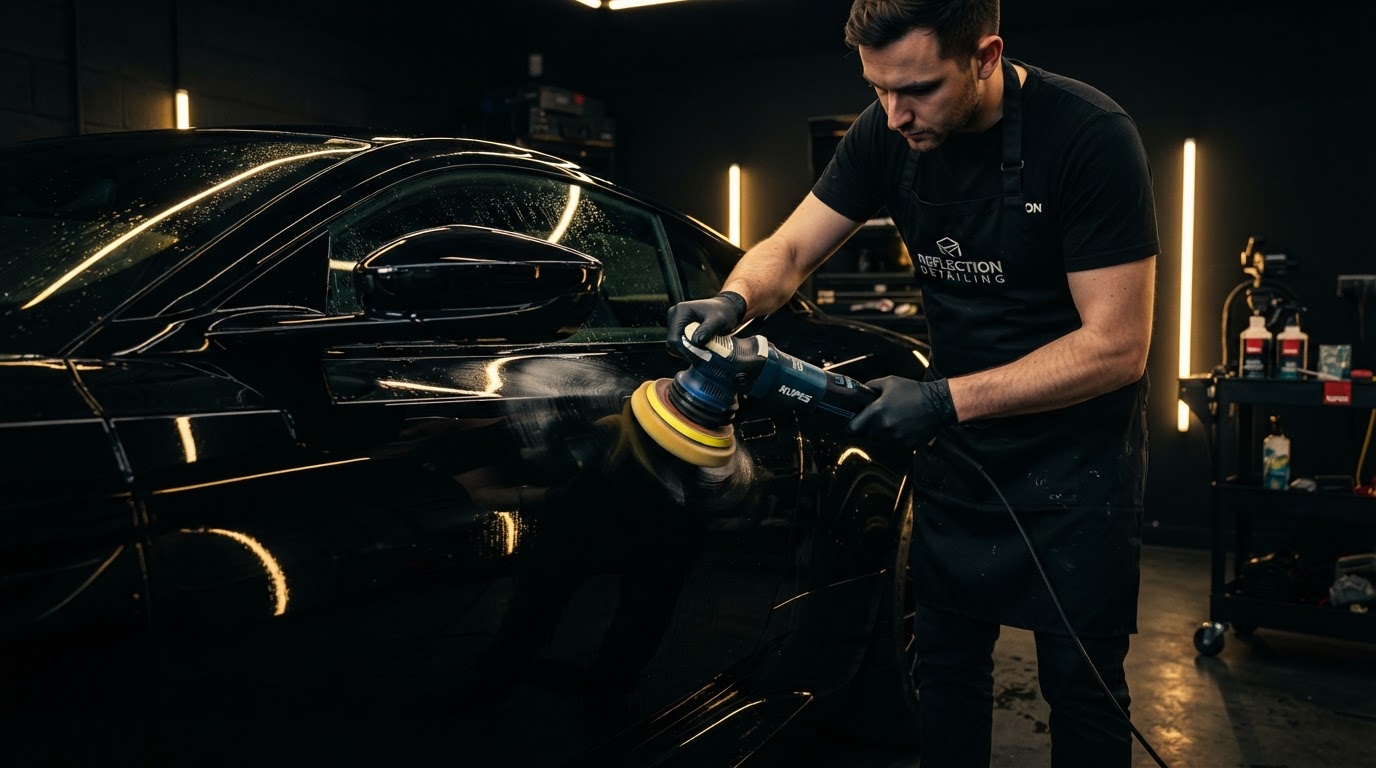
Paint Correction in NYC
Automotive paint correction to remove swirls, scratches and defects.
Paint correction in NYC is the process of refining automotive paint to remove defects like swirl marks, fine scratches, oxidation, and holograms. Using machine polishers and graded compounds, paint defect correction restores clarity and depth to the clear coat, dramatically improving the appearance of the finish.
What This Service Covers
Our Detailing Process
1Inspection & Decontamination
Paint is inspected under proper lighting and decontaminated so defects can be accurately assessed.
2Compound Stage
Heavier defects are leveled with a cutting compound and pad to remove deeper scratches and oxidation.
3Polish Stage
A finer polish refines the finish, removing compound haze and restoring gloss and clarity.
4Protection
A wax, sealant, or coating is applied to protect the freshly corrected paint.
Understanding Paint Defects
Understanding Paint Defects
Automotive paint is not a single layer but a system, with the clear coat sitting on top of the color coat to provide gloss and protection. Most visible defects — swirl marks, fine scratches, oxidation, holograms, and buffer trails — live within this clear coat. Paint correction is the process of safely leveling a microscopic amount of that clear coat to remove the defects and restore a flawless, reflective surface.
Swirl marks are the most common defect, appearing as a spiderweb pattern that shows up most clearly under direct light. They are typically caused by improper washing and drying, automatic car washes, and wiping the paint with dirty materials. Fine scratches from brushes, keys, and environmental contact add to the pattern, while oxidation dulls older paint that has lost its protective layer.
Holograms and buffer trails are the telltale marks of incorrect machine polishing — shadowy, wavy patterns visible in reflected light. Paint correction removes all of these defects, leaving a finish that reflects light cleanly and evenly. The result is a dramatic improvement in gloss, depth, and clarity that transforms the appearance of the vehicle.
The Paint Correction Process
The Paint Correction Process
Paint correction begins with a thorough inspection under proper lighting. Dedicated detail lighting reveals defects that are invisible in ordinary conditions, allowing the detailer to map the paint's condition and plan the correction. The vehicle is then washed and decontaminated — clay bar and chemical decontamination remove bonded contaminants so they do not interfere with polishing.
Correction itself is performed in stages. A cutting compound and pad remove the heavier defects, leveling the deeper scratches and oxidation. This stage leaves the paint improved but with a slight haze, which is then refined with a finer polish and finishing pad. The polish removes the compound haze, restores clarity, and brings out the full gloss and depth of the finish.
Throughout the process, the detailer works panel by panel, checking results under lighting and adjusting the combination of compound, polish, and pad to suit the paint's hardness and condition. Different paints respond differently, and experience determines the right approach for each. The result is a uniform, defect-free finish across the entire vehicle.
Swirl Mark Correction and Refinement
Swirl Mark Correction and Refinement
Swirl mark correction is often the most visible improvement from paint correction. Because swirls sit in the clear coat, they can be leveled away with the right combination of compound and polish. The spiderweb pattern that ruins reflections in sunlight disappears, replaced by a clean, mirror-like surface.
Refinement is the step that separates a good correction from a great one. After the cutting stage removes the defects, the polish stage removes the micro-marring that the compound leaves behind. Skipping or rushing this step leaves the paint looking improved but not flawless — still showing fine haze under strong light. A proper two-stage correction, with careful refinement, delivers the deep, wet-look gloss that defines a corrected finish.
For vehicles with lighter defects, a single-stage polish may be sufficient. This lighter process, covered in our car polishing service, enhances gloss and removes minor imperfections without the full leveling of a two-stage correction. The right approach depends on the paint's condition and the owner's goals.
Why Correction Should Be Followed by Protection
Why Correction Should Be Followed by Protection
A corrected finish is a flawless foundation, but it is also an unprotected one. The polishing process removes any existing wax or sealant, leaving the freshly revealed clear coat exposed to the elements. Without protection, new contaminants, UV, and improper washing will quickly reintroduce defects, undoing the correction.
This is why paint correction is best followed immediately by a protective layer. Car waxing offers short-term shine and defense. Synthetic sealants last longer. For the most durable protection, ceramic coating bonds chemically with the corrected paint to provide years of defense, water repellency, and gloss retention. A coating also makes the corrected finish easier to maintain, since contaminants wash off more readily.
The combination of correction and coating is the gold standard for paint care. The correction removes the defects; the coating locks in the flawless finish and protects the investment. For NYC drivers, where environmental exposure is constant, this pairing keeps paint looking its best for years rather than months.
When to Choose Paint Correction
When to Choose Paint Correction
Paint correction is the right choice when a vehicle's paint shows visible defects that washing and waxing cannot address — swirl marks under light, fine scratches, dullness from oxidation, or the holograms left by a previous, poor polishing job. It is also the ideal preparation for ceramic coating, which performs best on a flawless, defect-free surface.
The service is popular at key moments: before selling or returning a lease, after a harsh winter, when a vehicle has been through automatic car washes, or simply when an owner wants to restore a vehicle's appearance to its best. Luxury and exotic vehicles, whose paint is often more delicate and more closely scrutinized, particularly benefit from professional correction.
For drivers unsure whether their vehicle needs correction or a lighter polish, an inspection under proper lighting provides the answer. Once defects are mapped, the right level of correction can be recommended. Explore our car polishing, clay bar treatment, and ceramic coating services to see how correction fits into a complete paint care program.
FAQ
Paint Correction NYC — Frequently Asked Questions
Will paint correction remove all scratches?
It removes most light and moderate clear coat defects. Deep scratches that penetrate the paint may require repainting.
How long does paint correction last?
The correction itself is permanent, but the paint must be protected and maintained to prevent new defects.
Should I get ceramic coating after correction?
Yes. A corrected finish is the ideal base for ceramic coating, which locks in the gloss and protects the work.
What causes swirl marks?
Improper washing and drying, automatic car washes, and wiping the paint with dirty materials are the most common causes.
How is correction different from polishing?
Correction is a more aggressive, multi-stage process that removes deeper defects. Polishing is a lighter refinement for gloss.
Explore
Related Detailing Services
Interior Car Detailing NYC
Deep interior cleaning for seats, carpets, dashboard and every surface.
Exterior Car Detailing NYC
Exterior vehicle cleaning, paint care, wheels and surface protection.
Full Car Detailing NYC
Complete interior and exterior detailing in one comprehensive service.
Mobile Car Detailing NYC
On-site car detailing at your home, office, or location across NYC.
Ceramic Coating NYC
Automotive ceramic coating for long-lasting paint protection and gloss.
Car Polishing NYC
Car polishing for paint gloss enhancement and a flawless finish.
Serving All Five Boroughs
Ready for a Showroom-Quality Detail?
Mobile car detailing available across Brooklyn, Manhattan, Queens, Staten Island & the Bronx.