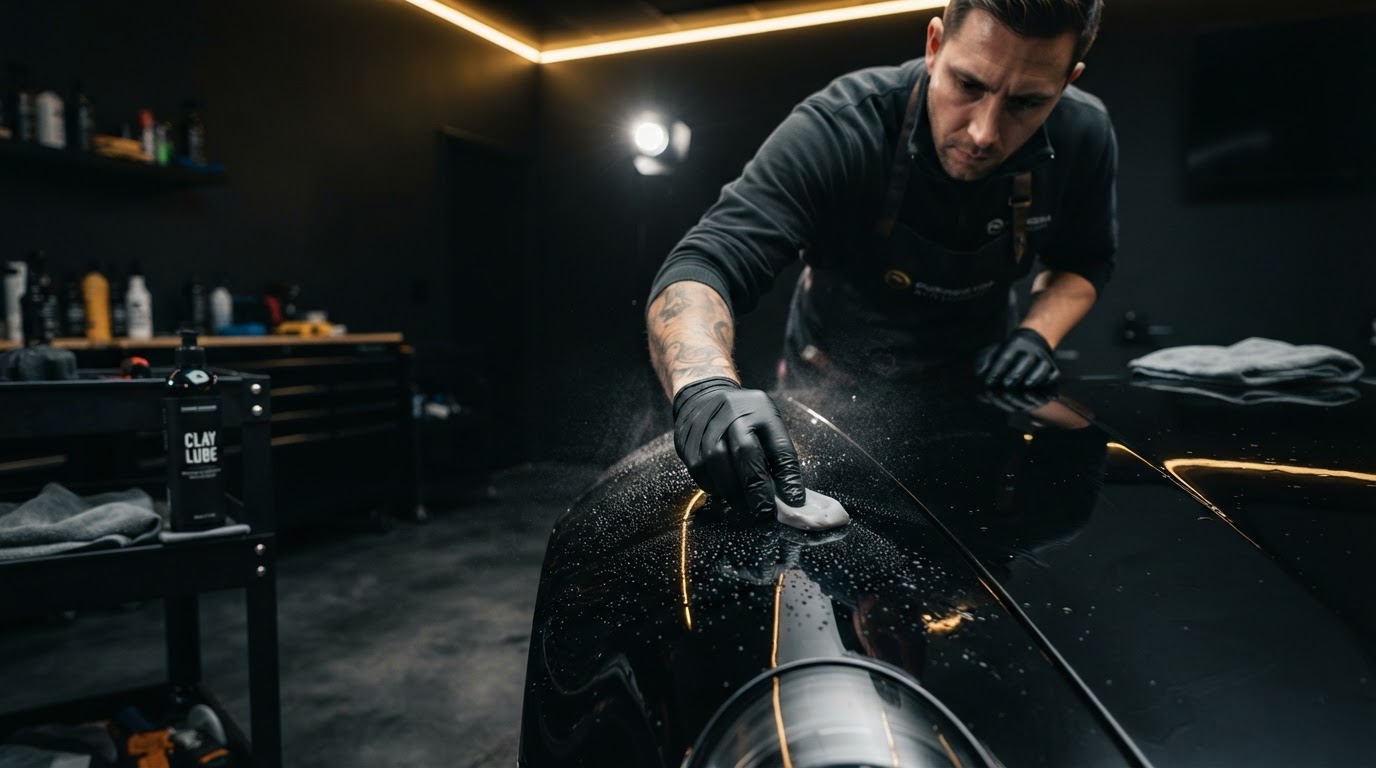
Clay Bar Treatment in NYC
Automotive clay bar treatment to remove bonded surface contamination.
Clay bar treatment in NYC removes bonded contaminants from your vehicle's paint that washing cannot. Automotive clay bar treatment lifts rail dust, tree sap, overspray, and industrial fallout from the surface, leaving the paint smooth and properly prepared for polishing or protection.
What This Service Covers
Our Detailing Process
1Wash
The vehicle is washed to remove loose dirt before claying.
2Clay
A lubricated clay bar is glided across the paint to pull bonded contaminants from the surface.
3Inspect & Protect
The now-smooth surface is inspected and ready for polish, wax, or coating.
What a Clay Bar Removes
What a Clay Bar Removes
A clay bar removes bonded contaminants from vehicle paint — the particles that wash away from the surface but remain embedded in or adhered to the clear coat. These include rail dust from transport, industrial fallout, tree sap, overspray, brake dust, and the airborne pollution that settles on every vehicle in an urban environment like NYC.
These contaminants are not visible to the eye in most cases, but they are easy to feel. Running a hand over contaminated paint reveals a rough, gritty texture, even after a thorough wash. This roughness is the bonded contamination, and it is what a clay bar is designed to remove. The clay pulls these particles from the surface, leaving the paint perfectly smooth.
Removing this contamination matters for both appearance and protection. Bonded contaminants dull the finish, interfere with the bonding of wax and coating, and in the case of acidic contaminants like sap and bug residue, can damage the clear coat over time. Claying restores the smooth, clean surface that protection and polishing require.
The Clay Bar Process
The Clay Bar Process
Claying begins with a thorough wash to remove all loose dirt. Claying a dirty surface would drag that dirt across the paint and cause scratching, so the wash is an essential first step. Once the vehicle is clean, a clay lubricant is applied to a section of paint, and the clay bar is glided gently across the surface.
As the clay moves over the paint, it picks up the bonded contaminants, pulling them from the clear coat. The detailer works in small sections, folding the clay to encapsulate the contamination and expose a clean surface. The process is repeated until the paint feels perfectly smooth, with no grit or roughness.
After claying, the surface is inspected to confirm it is fully decontaminated, and the vehicle is ready for the next step — polishing, waxing, or ceramic coating. The now-smooth surface accepts these treatments better, with improved bonding and gloss. The clay bar is a preparation step, but it is one of the most important for achieving a high-quality result.
Why Claying Is Essential Before Protection
Why Claying Is Essential Before Protection
Wax, sealant, and ceramic coating all bond to the paint surface. If that surface is contaminated, the protection bonds to the contamination rather than the paint, which compromises both the appearance and the durability of the protection. Contaminants trapped beneath a coating or wax can also continue to damage the clear coat.
This is why claying is an essential preparation step before applying any protection. By removing all bonded contaminants, the clay bar ensures the protection bonds to clean, smooth paint, maximizing its performance and lifespan. For ceramic coating in particular, claying is non-negotiable — a coating applied over contaminated paint will not bond properly and will fail prematurely.
Claying is also valuable before polishing. Bonded contaminants can interfere with the polishing process, clogging pads and causing uneven results. A decontaminated surface polishes more evenly and achieves a better finish. For any paint care that goes beyond a basic wash, claying is the foundation.
Mechanical Decontamination and Chemical Decontamination
Mechanical Decontamination and Chemical Decontamination
Clay bar treatment is a form of mechanical decontamination — it physically pulls contaminants from the surface. It is often combined with chemical decontamination, which uses specialized chemicals to dissolve specific contaminants. Iron removers dissolve ferrous particles like brake dust and rail dust, while tar and sap removers tackle their respective contaminants.
The combination of chemical and mechanical decontamination provides the most thorough result. Chemicals dissolve what they can, and the clay bar removes what remains. This two-step approach is what our car paint decontamination service covers, and it is the standard preparation for advanced services like paint correction and ceramic coating.
For lighter needs, a clay bar treatment alone may be sufficient. The right level of decontamination depends on the vehicle's condition and the services that will follow. An inspection reveals the type and extent of contamination, and the detailer can recommend the appropriate approach.
How Often to Clay a Vehicle
How Often to Clay a Vehicle
Claying is not needed with every wash. It is a periodic treatment, typically performed as part of a detail or before applying protection. For most NYC drivers, claying once or twice a year — usually as part of a spring and fall detail — keeps contamination under control and prepares the paint for protection.
The need for claying is easy to assess. After washing, feel the paint; if it is rough or gritty, it has bonded contamination and would benefit from claying. If it is smooth, claying is not immediately necessary. This simple test helps drivers time the treatment so it is performed when needed rather than on a fixed schedule.
Explore our car paint decontamination, car polishing, and ceramic coating services to see how claying fits into a complete paint care program. As a standalone treatment or the preparation step for more advanced care, clay bar treatment is essential for smooth, clean, well-protected paint.
FAQ
Clay Bar Treatment NYC — Frequently Asked Questions
Is clay bar safe for my paint?
Yes, when used with proper lubrication by an experienced detailer.
How do I know my car needs claying?
If the paint feels rough or gritty after washing, it likely has bonded contaminants.
Should I clay before ceramic coating?
Yes. Decontamination is a required step before applying ceramic coating.
How often should I clay my car?
Once or twice a year is typical, usually as part of a seasonal detail.
What is the difference between claying and chemical decontamination?
Claying mechanically pulls contaminants from the surface; chemicals dissolve specific contaminants like iron and tar.
Explore
Related Detailing Services
Interior Car Detailing NYC
Deep interior cleaning for seats, carpets, dashboard and every surface.
Exterior Car Detailing NYC
Exterior vehicle cleaning, paint care, wheels and surface protection.
Full Car Detailing NYC
Complete interior and exterior detailing in one comprehensive service.
Mobile Car Detailing NYC
On-site car detailing at your home, office, or location across NYC.
Paint Correction NYC
Automotive paint correction to remove swirls, scratches and defects.
Ceramic Coating NYC
Automotive ceramic coating for long-lasting paint protection and gloss.
Serving All Five Boroughs
Ready for a Showroom-Quality Detail?
Mobile car detailing available across Brooklyn, Manhattan, Queens, Staten Island & the Bronx.